
Why Your Heat Pump Might Not Be Living Up to the Hype
We've all seen the glossy brochures. Air source heat pumps are sold as the future of heating: low-carbon, low-cost, and good for the planet. But for plenty of homeowners across the UK, there's a frustrating gap between what a spreadsheet promised and what actually turns up on the electricity bill — a heat pump running all the time without ever quite warming the house.
If your heat pump feels like it's working overtime — or costing more than your old gas boiler — the problem might not be the heat pump at all. It could be something the industry calls the “heat pump performance gap.” This post explains what that gap is, why it happens, and how a thermal imaging survey and an accurate heat loss calculation can help close it.
The “Perfect” House vs. Your Actual House
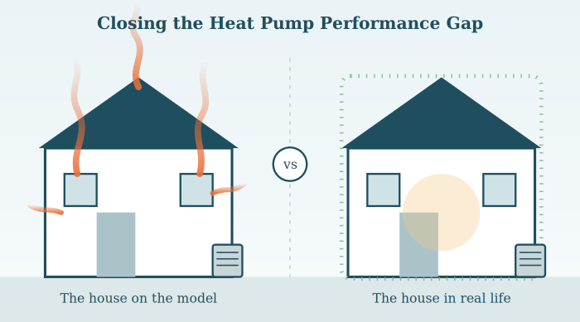
When heating systems are designed, engineers use software that imagines your home as a neat, perfectly sealed box. In that world, insulation is flawless, joins are airtight, and warm air politely stays where it's meant to.
Real homes aren't like that — especially older UK homes or retrofits. In real life, that lovely insulating “blanket” usually has a few holes in it.
The Two Biggest Heat Thieves
There are two main reasons homes lose more heat than the calculations suggest. Think of it like wearing a top-of-the-range winter coat... but leaving the zip open and having a few holes under the arms.
The “Short Circuit” (Cold Spots in the Building)
You might have good insulation in your walls, but if something like a steel beam, window frame, or badly fitted insulation runs through it, heat can sneak straight past. This is exactly what an insulation survey is designed to catch.
In real homes, we often find:
- Gaps where insulation doesn't quite meet at corners
- Bits of insulation missing or slumped inside walls
- Cold bridges around windows, doors, and floors
These small issues can add up to as much as 30% of your heat loss — without you ever seeing them.
The Invisible Thief (Draughts and Air Leaks)
Heating software assumes walls and floors are solid. In reality, warm air is often escaping through tiny gaps you can't see — under floorboards, behind skirting boards, around pipes, or where cables come through walls.
If warm air is leaking out, it doesn't matter how thick your insulation is. You're basically paying to heat the outdoors.
Why Heat Pumps Feel This More Than Boilers
A common question is: “My old gas boiler managed fine — so why is my heat pump struggling?”
Think of a gas boiler like a bonfire. If the house is draughty, it just burns harder to compensate. It's wasteful, but you stay warm.
A heat pump is different. It's more like a slow cooker than a blowtorch. It works best when it can gently top up heat over a long period.
- In a well-sealed home: the heat pump runs at a low temperature and stays efficient (cheap to run).
- In a leaky home: it has to push the flow temperature higher to keep up — and that's when efficiency drops and bills climb.
How to Close the Performance Gap
If your heat pump isn't delivering, don't write it off just yet. The aim is to make real life look a bit more like the tidy theory — and that starts with finding out exactly where your home is losing heat.
Here's where to start
See what's really going on
A thermal imaging survey carried out during cold weather can be eye-opening. It shows exactly where heat is leaking out — often in places you'd never expect.
Stop the draughts first
Before spending thousands on more insulation, spend a few hundred on proper draught-proofing. Sealing gaps around floors, pipes, and walls can make a huge difference to how a heat pump performs.
Installation matters more than thickness
It's not just how much insulation you have — it's how well it's fitted. Even a 10mm gap behind insulation can slash its effectiveness, which is why a dedicated insulation survey looks at installation quality, not just depth.
The Bottom Line
A heat pump can only ever be as good as the house it's heating. By fixing draughts, sealing gaps, and tackling hidden cold spots, we can close the performance gap — and finally get the comfort, lower bills, and carbon savings that heat pumps promise.
What Could I Do Next?
- Pay attention to the signs. If your home takes ages to warm up, feels draughty, or your electricity bills are higher than expected, those are clues that heat is leaking out somewhere.
- Deal with draughts first. Before spending big money, tackle the basics. Sealing gaps around doors, windows, skirting boards, floors, and pipework is often cheap and surprisingly effective.
- Get a thermal imaging survey. Done in cold weather, this can show exactly where heat is escaping — walls, windows, floors, and hidden cold bridges. It's one of the quickest ways to understand what's really going on.
- Check insulation quality, not just quantity. More insulation isn't always the answer. Ask whether existing insulation is continuous, well-fitted, and actually doing its job.
- Make sure your installer looks at the whole house. A heat pump shouldn't be treated as a “plug-and-play” boiler swap. Good installers consider airtightness, heat loss, and radiator sizing — not just the unit itself. A proper room-by-room heat loss calculation gives them the numbers to get sizing right.
- Don't be afraid to ask. Don't just accept a sales-based survey — ask about their findings. Where are the weak spots? How will they affect performance? Are they factored into the proposal? What's the likely gap between the model and reality? Ask, ask, ask. If they don't answer to your satisfaction, walk away.
- Don't give up on heat pumps too quickly. Many underperforming systems can be fixed by improving the building, not replacing the technology.
Get an Independent Second Opinion
CWE Consultants carries out thermal imaging surveys, insulation surveys, and room-by-room heat loss calculations across Swindon and Wiltshire and because we don't install anything ourselves, our findings are entirely independent of any installer's sales pitch. If you'd like a clearer picture of where your home is losing heat, or you're planning a heat pump and want a proper retrofit assessment first, we're happy to help.
Get in touch
Make an enquiry via our website or
email us directly at info@cweconsultants.com and
we'll talk you through your options — no obligation, no installer sales pitch.